
Verdun
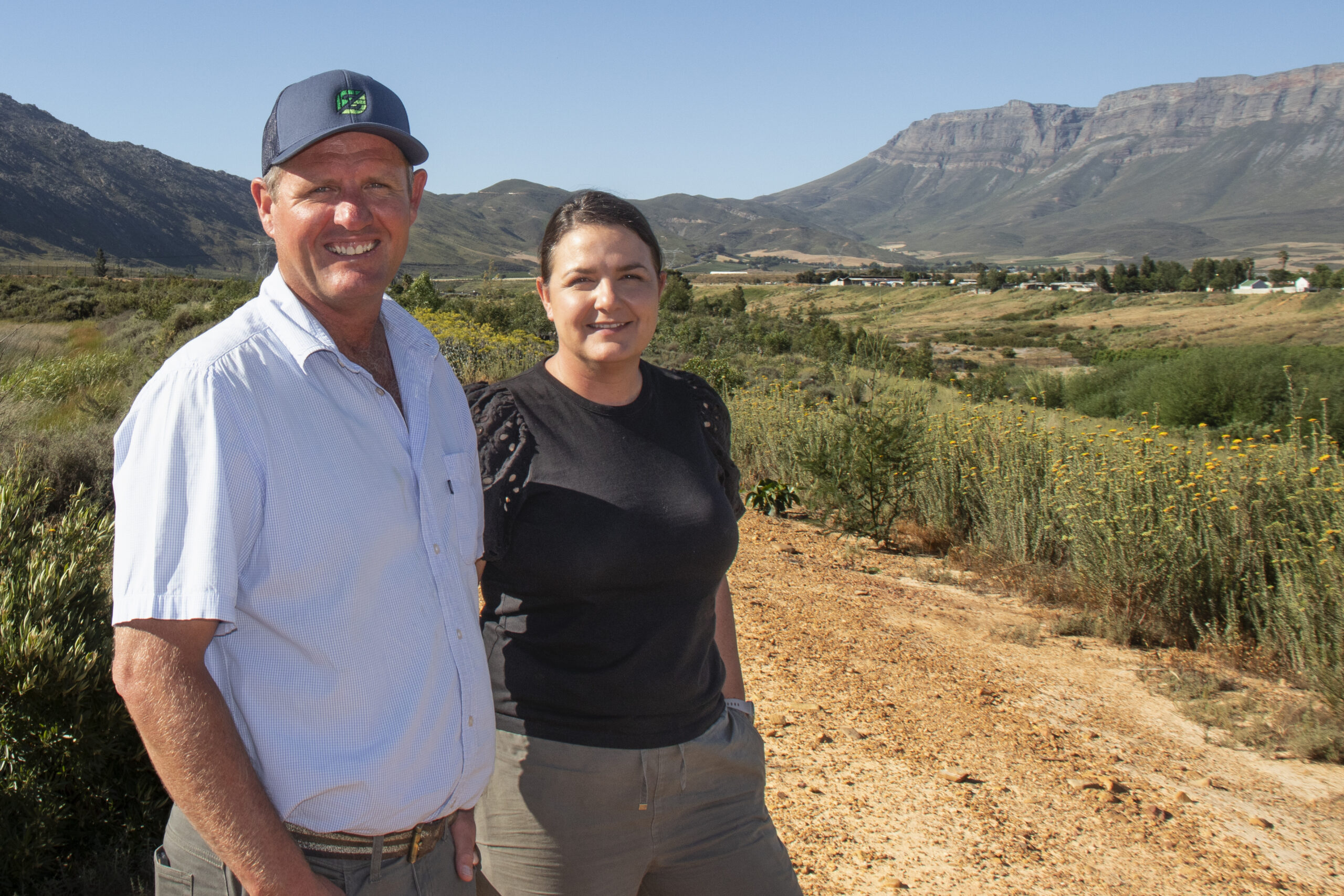
The brother-and-sister team of Peter Wolfaardt and Georgie Hewitt discuss their top-performing August Red nectarines. By Anna Mouton.
Verdun in Prince Alfred Hamlet is home to some of the South African stone-fruit industry’s foremost August Red blocks, according to an analysis by the agricultural economics company FruData of metrics such as yields and pack-outs.
“We have two August Red blocks next to each other,” says Georgie Hewitt. “The pack-outs depend on the year, and whether our nights are cold enough for good colour development, but the two blocks produce 8 000–10 000 export cartons per hectare on average, not including local cartons.”
The one block, which Hewitt fondly calls Ouma, was established in 1993 (that’s not a typo — Ouma is 33 years old) at 4.5 x 1.0 metres, and covers 1.2 hectares. The other block was established in 1999, measuring 4.5 x 1.5 metres and covering 2.7 hectares.
Verdun has a total of about 275 hectares under irrigation, of which 85% is stone fruit, mostly nectarines, and the rest is pears. Their stone-fruit harvest season runs from the second half of November to the middle of March, with pears finishing in early April.
Blessed with good genes
“Genetic innovation has always been a big part of our business,” says Peter Wolfaardt. “My grandfather planted the first new-generation nectarines in the Warm Bokkeveld in the early 70s. And my parents planted quite a few new pear varieties.”
When it was patented in 1988, August Red represented superior genetics. “It was better than anything else,” recalls Wolfaardt. “It’s a big, round, very clean fruit. And it stays firm, whereas the generation of nectarines before it tended to get soft tips.”
Although he thinks there are newer cultivars with better eating quality, Wolfaardt would plant August Red again because it’s easy to grow. Nonetheless, he is keen to trial improved genetics.
“But there is no perfect variety. Even if you plant good genetics, you will still have issues that you need to figure out,” he says. “The varieties all differ in their reaction to whatever you do. And it’s harder to know the best time to pick the new varieties, because the fruit all looks the same.”
Hewitt agrees, stressing the importance of extensive sampling to determine harvest maturity. “Once you have all the information, you must decide to pick on a colour, size or finish, based on your samples and experience. But you need to know your varieties and your orchards, and keep ahead of the game.”
In her experience, August Red can develop internal browning if harvested prematurely. However, when picked at the correct firmness and immediately packed and shipped, August Red travels well and isn’t prone to postharvest disorders.
Above and below ground
Both August Red blocks are on Kakamas seedling rootstocks. Wolfaardt has tried many rootstocks, and each has its advantages and disadvantages. “It’s horses for courses,” he comments. “Kakamas is quite hardy, but nematode sensitive, so not always the best in terms of replant.”
However, Kakamas is the most dwarfing rootstock, and Verdun’s warm, humid, wind-free microclimate tends to promote vigour. Verdun also has blocks on Viking, which is less prone to pests and diseases and more tolerant of wet conditions than Kakamas.
“Viking does very well on this farm, but it’s quite vigorous,” says Wolfaardt. “It costs us a lot of money to farm Viking because it requires a lot of summer pruning. We do get really good fruit size on Viking, but Kakamas is our best rootstock in terms of tree manipulation.”
Of the two August Red blocks, Ouma is on stony soil, and the younger block, which is closer to the river, has a patchwork of sandy and heavier, loamy soils. In both blocks, the trees are trained as central leaders.
“That’s how people trained trees in those days, with branches instead of bearing units,” says Wolfaardt. “We don’t create branches anymore — we create bearing units.”
If he had to establish this orchard again, he would probably space the trees 1.5 metres apart, and train them on a V-trellis. “Your biggest issue with August Red is that you need more space to put fruit, because it can bear more,” he says.
Dealing with variable soils
While the microclimate at Verdun provides good growing conditions and promotes high pack-outs of clean fruit, at least in dry years, the site is generally humid, and pest and disease pressure can be high.
The variable soils are also challenging to irrigate, says Hewitt. “My father always said that we thought this was a great stone-fruit farm, until we had our second farm,” she jokes.
“Five or ten years ago, when we designed a new block, the irrigation was homogeneous,” says Wolfaardt. “Now we plan our irrigation according to the soil samples and classification. If we have a sandy patch in the middle of a block, it has its own tap.”
Verdun has also adopted precision fertilisation, in consultation with soil scientist Mico Stander of Agrimotion. They base tree nutrition on soil samples and NDVI images (used to assess plant vigour), and apply granular fertilisers with a GPS-enabled variable spreader.
In addition to reducing their overall fertiliser bill, Hewitt highlights another benefit of precision fertilisation. “I think the biggest secret to nectarine farming is keeping your trees in balance,” she says. “Giving a tree too much food can be just as detrimental as giving it too little, and with the variable soils, variable applications make a big difference.”
More recently, Verdun has begun implementing organic soil amendments. They have already found that compost at planting and straw mulch suppresses nematodes. They are now experimenting with cover crops on one of their other sites.
“Hendrik Pohl is helping us look at different scenarios — different cover crop mixes, mulches, and weed control,” says Wolfaardt. “When we have an idea of which ones work best for which conditions, we’ll roll it out to our other production units.”
A productive life
Much of August Red’s success can be attributed to its reliable performance, consistently producing high yields and large fruit. Despite the age of the cultivar, it’s also still widely accepted in the market.
Wolfaardt finds that, as both August Red blocks have aged, their bearing units are less evenly spaced in the canopy, and trees bear less evenly within the orchard. When managing crop load, it’s no longer possible to achieve an optimal distribution of fruit across shoots.
“You have to take what you can get, but with August Red, if you have too many fruit on one shoot and nothing on another, it doesn’t make a big difference,” he says. “I think that’s partly why they last so long. You can move your crop around in your block or on your tree without massively impacting fruit size.”
Every March, Hewitt and Wolfaardt, together with their production managers and technical advisers, assess all their blocks, categorising them as green, yellow, orange, or red based on their performance and the level of intervention required.
As Hewitt tells it, horticulturist Piet Nieuwoudt doesn’t even want to visit Ouma anymore, considering her overdue for replacement. But Hewitt argues that Ouma still pulls her weight.
“She’s not at the top anymore because new genetics have surpassed that orchard,” says Hewitt. “But Ouma is still in our middle third in terms of net farm income.”
And to be honest, Hewitt has a soft spot for the old August Red block. “It’s my favourite orchard,” she admits. “Ouma has made enough money over her lifetime to establish probably half the other orchards in our business.”
Caption: Peter Wolfaardt and Georgie Hewitt [Credit: Anna Mouton]
Related Posts
Patensie does it again!
Honey Katoo takes top honours at Agri’s Got Talent 2026 For immediate release: 17 October…
Dennegeur’s Stephan Beukes | Western Cape Farmer of the Year
WESTERN CAPE — Stephan Beukes of Dennegeur Farms in Grabouw has been named the 2026…

Ek was daar | The roadmap of Anton Rabe
For more than three decades, Anton Rabe has been part of the story of South…
Jaco Wolmarans wins Hortgro Photo Competition 2026
Somerset West – Hortgro is proud to announce Jaco Wolmarans as the winner of the…