
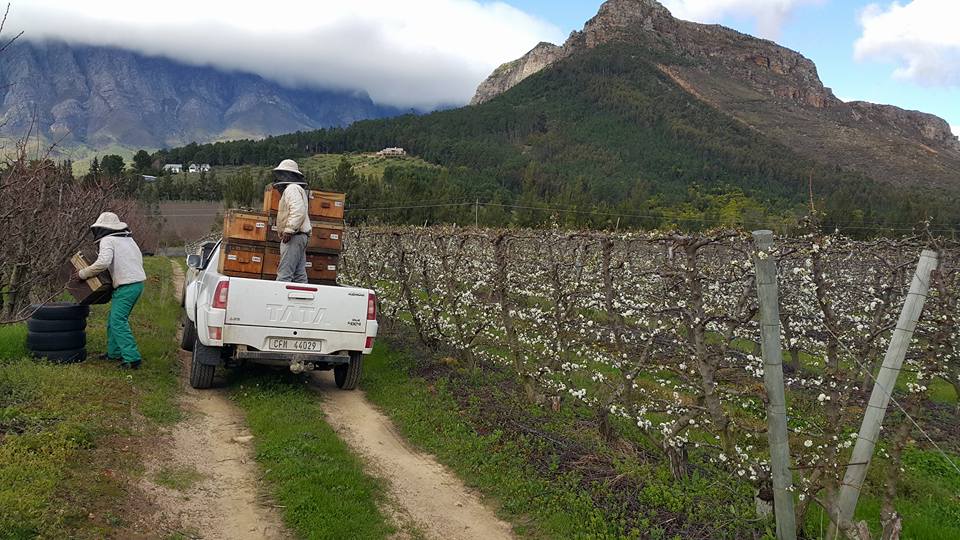
Pollination in the spotlight
It is that time of year when pollinators work hard to ensure a successful production season. Dr Nanike Esterhuizen, Hortgro Science Crop Protection Applied Researcher, shares answers to questions she regularly receives about pollination.
How important are pollinators to the pome industry in general, and what estimated impact does effective pollination have on yield and quality?
Commercial pollination by managed honeybees is a crucial production input in the deciduous fruit industry, particularly for pome fruit. Many commercial apple and pear cultivars are self-incompatible and require compatible cross-pollination, primarily facilitated by insect pollinators, including managed honeybees. Effective pollination is therefore critical to production. It influences fruit set, seed number, fruit development and size, and ultimately fruit quality. Inadequate pollination can reduce grower revenue through both reduced yield and reduced fruit value, where smaller or misshapen fruit may be less likely to meet higher-value market grades.
The stocking rate, strength and quality of honeybee colonies used for pollination also affect pollination outcomes. During blossom, honeybee stocking rates for pome fruit are commonly in the range of 2 to 5 colonies per hectare, although this varies according to crop, cultivar and environmental conditions. However, hive numbers alone do not guarantee an adequate pollination service, and growers should work with reputable beekeepers who adequately prepare their colonies to an appropriate strength before the pollination period. Using registered beekeepers who meet recognised pollination standards will help ensure an appropriate pollination service.
What pollination management practices do pome fruit farmers usually incorporate?
Orchard design underpins effective pollination. Key considerations include selecting compatible polliniser cultivars, positioning pollinisers to facilitate adequate pollen distribution throughout the orchard, and ensuring sufficient overlap in flowering periods between the polliniser and commercial cultivars.
Orchard management during the pollination period is equally important. Providing bees with access to adequate water and diverse forage can support colony health and foraging activity during pollination. Flowering cover crops and other non-crop plants may provide important nutritional resources for honey bees, particularly where the orchard crop does not provide a nutritionally balanced diet on its own.
At the same time, minimise pesticide exposure during flowering. Where pesticide applications are necessary, select bee-friendly products or products with low toxicity to bees where possible. Apply pesticides when bees are not actively foraging, in accordance with product-label requirements, and notify beekeepers well in advance of planned applications so they can move bees if necessary.
Do your farmers usually work directly with beekeepers, and what do you think makes a successful farmer–beekeeper relationship?
Yes, in South African commercial deciduous fruit production, growers commonly obtain pollination as a contracted service directly from beekeepers. A successful grower-beekeeper relationship is based on good two-way communication and respect for the service honey bees provide, rather than a simple transaction based on how many hives are delivered to the farm. Repeated seasonal cooperation also strengthens grower-beekeeper relationships.
A written contract specifying hive numbers, placement, service period, access, payment, pesticide notifications, and responsibilities is crucial. Booking hives early is essential to reserve sufficient colonies before the pollination peak. Growers must notify beekeepers about bloom timing and spray plans; they should coordinate crop-protection decisions with beekeepers to minimise the risk of exposing colonies to harmful pesticides during pollination.
What are the biggest challenges your farmers usually face in maintaining effective pollination?
There are a number of practical considerations around pollination that could pose challenges. For example, the weather during bloom. Cold, rain, wind or unusually hot conditions can restrict bee flight precisely when flowers are receptive. Another factor is when growers do not use reputable beekeepers, as weak or poorly timed colonies may not deliver enough foragers to complete the pollination task. Insecticides or poorly timed pesticide applications can also kill bees or reduce their foraging activity.
From an orchard design perspective, challenges can arise in large blocks when bees are not optimally placed to access the entire block. Protective netting can also complicate pollination. In some fixed or fully enclosed net structures, bees can become disorientated or have difficulty navigating between the orchard and their hives, potentially reducing pollination efficiency. The effect will depend on the design and size of the netted area and on hive placement.
On a broader scale, because the South African deciduous-fruit industry relies heavily on a healthy honey bee population and a viable beekeeping sector, threats to the beekeeping industry also threaten fruit production. The beekeeping sector faces many challenges, including increased droughts, fires, and bee diseases, but one major issue is the loss of forage needed to sustain the number of colonies required to meet the ever-growing agricultural demand across industries.
In the Western Cape, the main users of commercial honey bees include deciduous fruit, berries, nuts and seed production. A bottleneck during the spring pollination period, around September, when all these industries need commercial pollination services, could result in a shortage of honey bee colonies. The best way to support both the beekeeping and fruit production sectors is to secure, conserve, and create honey bee forage resources.
Can you put a financial value on good pollination in pome fruit farming operations?
It is difficult to put an exact value on pollination. Paying for the service provided by beekeepers is usually a high-return investment, as the direct cost of pollination is relatively small compared with the value of the crop at risk from inadequate pollination.
Using the 2024 Western Cape Bee Industry Association guideline tariff of approximately R1,266.70 per colony, the direct cost of pollination would be approximately R2,500 to R6,300/ha at a stocking rate of two to five colonies per hectare, excluding VAT. The potential cost of inadequate pollination, through reduced fruit set and lower fruit quality, can be substantially greater than the cost of the pollination service.
A 2025 study by Veldtman and De Lange estimated that insect pollination contributed more than USD 1.5 billion to South African crop production in 2018, which is equivalent to 42.2% of the annual production value of insect-pollination-dependent crops in South Africa. Apples accounted for 19.53% of this estimated pollination value, or about USD 294 million in 2018. However, this figure represents the estimated value of insect pollination broadly and does not distinguish between managed honeybees and wild pollinators.
Related Posts

Patensie does it again!
Honey Katoo takes top honours at Agri’s Got Talent 2026 For immediate release: 17 October…
Dennegeur’s Stephan Beukes | Western Cape Farmer of the Year
WESTERN CAPE — Stephan Beukes of Dennegeur Farms in Grabouw has been named the 2026…

Ek was daar | The roadmap of Anton Rabe
For more than three decades, Anton Rabe has been part of the story of South…
Jaco Wolmarans wins Hortgro Photo Competition 2026
Somerset West – Hortgro is proud to announce Jaco Wolmarans as the winner of the…