
Burn Baby Burn | Invasive Tree Management Builds Water Security
Liz Metcalfe is co-director and organisation coordinator at Living Lands. She spoke to Jenny Underhill about the ongoing restoration of the Wabooms River catchment, which feeds the Joubertina Dam in the Langkloof. One of their strategies is to burn alien trees – an action that will help build water security.
Metcalfe moved to Joubertina in 2016 to join Living Lands, a non-profit company (NPC) serving the Baviaanskloof and Langkloof communities. She has extensive experience in landscape restoration and has been in the sector for over 15 years.
“Living Land’s expertise is ecological, but our heart is really with people, particularly in rural agricultural areas. Our work focuses on livelihoods and sustaining agriculture in the Eastern Cape. Across South Africa, large tracts of land are being managed by farmers, and sometimes they need support,” said Metcalfe.
In 2008, the founders of Living Lands started a thicket restoration project in the Baviaanskloof and soon realised how important it was for the region’s water security. Their work expanded into fynbos vegetation in the Langkloof, where their projects focus less on vegetation loss and more on removing invasive species.
“Even though there are some differences in terms of the detail of what we do in each region, the bigger picture is water security and climate resilience,” explained Metcalfe. “As an NPC, our approach is unique because the majority of our team live and work in the communities they serve. We build relationships, start by listening and are committed to long-term restoration.”
Water security is dependent on catchment health
“Most farms in the Langkloof are quite large, but only a tiny proportion of the land at the bottom of the valleys is cultivated. The rest is steep mountains. These mountains are beautiful but so difficult to manage, and it’s really expensive to clear invasive trees. That’s why I have a lot of respect for farmers, who are expected to shoulder this burden,” said Metcalfe.
In particular, Metcalfe wishes to recognise the vision and support of Marius van der Westhuizen, District Manager (Langkloof) of Southern Fruit Growers and chairperson of the Wabooms Irrigation Board.
“He sees the bigger picture. Although the orchards are his day-to-day focus, he understands that irrigation water comes from the catchments, and that less water is available as the climate changes. If we’re not managing water resources well – and we’re letting these catchments become overrun by invasive trees – farming in the Langkloof will become challenging.”
Stakeholder engagement for the prescribed burn
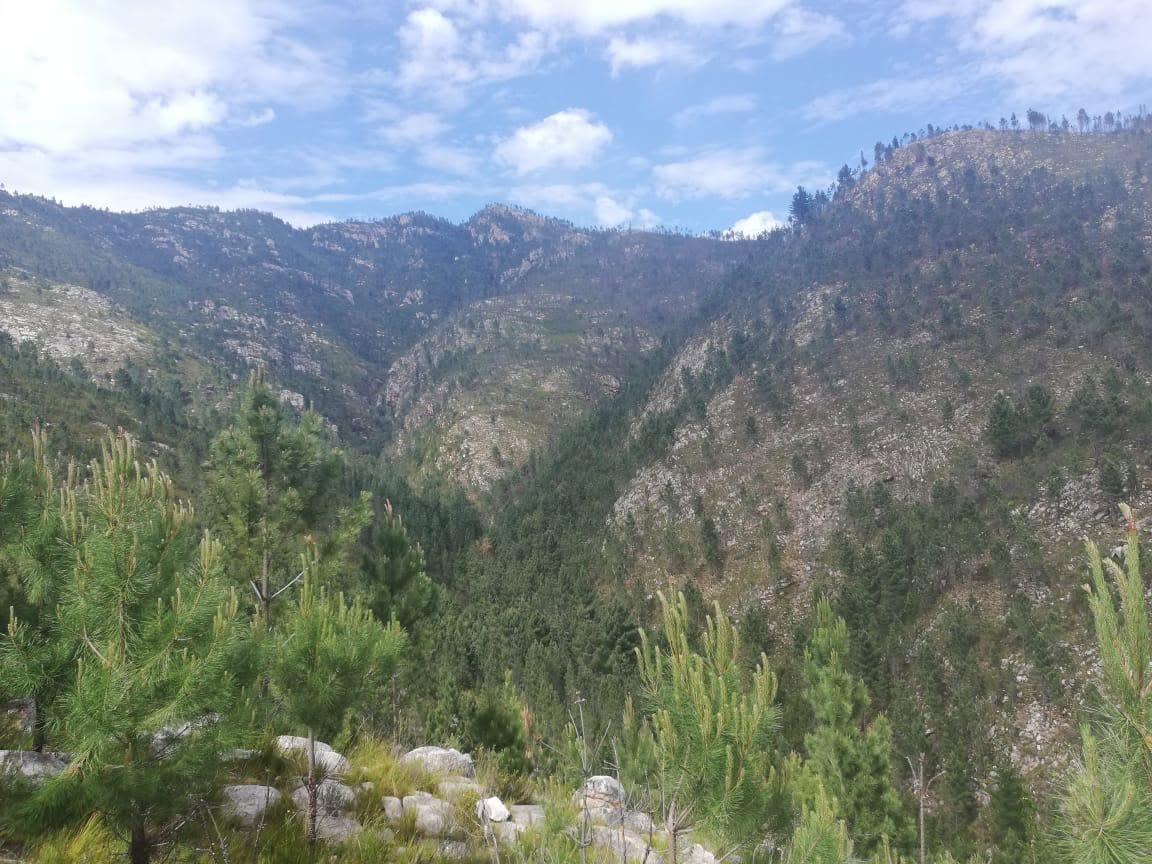
The Joubertina Dam is a municipal dam supplying water to the town of Joubertina and to farmers for irrigation. The Wabooms River catchment feeds it. Prior to 2024, the catchment’s fynbos vegetation – naturally fire-adapted – had not burned for more than 15 years and was overgrown with thirsty invasive pine trees.
“We had drought conditions from 2016 all the way through to 2020, a bit of rain, and then drought again. The dam level just kept getting lower and lower. We knew we had to clear the pine trees to improve water security, but the trees were too mature to clear manually,” explained Metcalfe.
A wildfire came through a piece of land alongside the catchment in 2021, which meant that there was a piece of cleared land to burn against – lessening the chance of a runaway fire. It prompted Living Lands to discuss a prescribed burn to initiate landscape restoration.
The catchment comprises land owned and managed by multiple stakeholders including the Wabooms Irrigation Board, Eastern Cape Parks Board, SANPARKS and farmers. “Fire is risky, and people were nervous. Everybody said, ‘You’re not going to get permits, it’s going to be impossible’. But bit by bit we spoke to all the role players and painted a picture of what we wanted to do,” said Metcalfe.
Living Lands and the Southern Cape Fire Protection Association (SCFPA) developed a plan for the prescribed burn, working alongside Southern Fruit Growers, Tulpieskraal and the Wabooms Irrigation Board. It took two full years of stakeholder engagement and preparation.
The SCFPA determined where to place ignition lines and firebreaks, and the Living Lands team cleared them. Living Lands paid the SCFPA to perform the burn through funding from the Global Water Challenge replenishment programme.
The team then had to wait over a year for the perfect wind direction, humidity, and temperature. The fire needed to start in summer to grow hot enough to kill the pine trees. Metcalfe said they had a false start in February 2024. “We got everyone there. The SCFPA was ready and waiting. But then the wind direction changed, and we had to send everybody home.”
A second chance came a month later in March 2024, and the burn went according to plan. “There were a few areas where we thought it might jump and we had a few flare-ups as expected. For three days, our team was on the ground to support the SCFPA and to keep an eye on the fire – day and night. Local farmers brought water cars, extra labour and equipment.”
The outcome of the fire
A total of 190 hectares of land burned in the Wabooms River catchment. The Living Lands team waited for a year to determine what percentage of the pine trees had died. The mortality rate was about 80%, and the team subsequently ring-barked any that survived to ensure 100% mortality. They have also installed erosion control structures and reseeded the burned areas with fynbos seed to minimise soil washing into the dam following the burn.
Based on calculations comparing the water use of a hectare of mature pine trees with a hectare of fynbos, clearing the catchment is estimated to recover 625 million litres of water annually.
Metcalfe recalled that the Langkloof had unusually good rains in 2024 after the burn, and the dam was full in February 2025 at the end of summer, which hadn’t happened in years. In contrast, 2025 and 2026 have been far more variable, with a mix of drought and extreme floods. Metcalfe is pragmatic. “We cannot make it rain more, but by clearing the pines we can try and make sure that the rain that does fall in the mountains makes it into the dam.”
Landscape restoration is a long-term project
Living Lands is proud that the burn was a success, but Metcalfe is at pains to state that the Wabooms River catchment restoration requires long-term commitment. “There is still pine seed in the soil, and over the next six years the pine trees will regrow. There has to be a follow-up burn in around seven years, once there is enough biomass to catch alight, but not so much that the new pines have started seeding. This is how you deal with pines: you have to do at least two, if not three, burn cycles.”
Living Land’s work in the Wabooms River catchment is informing their strategy for landscape restoration in the wider Langkloof region. The team is currently engaging with stakeholders to develop an environmental management plan that will include a burn programme for private farmland, conservation areas and adjacent properties.
“These landscapes are dynamic, and timing is everything. We would like to replicate the prescribed burn in other catchments in the Langkloof, but we need to wait for the right opportunities to arise. For example, if a wildfire clears an area that we can burn against, that will be the time to move in. But we would first need to spend time getting all the role players on the same page and developing a shared vision. That’s the secret sauce to make this work.”
Caption: Removing alien invasive pine trees such as these pictured here in the Langkloof mountains is crucial to ensure water security (Picture: Living Lands)
Related Posts

Patensie does it again!
Honey Katoo takes top honours at Agri’s Got Talent 2026 For immediate release: 17 October…
Dennegeur’s Stephan Beukes | Western Cape Farmer of the Year
WESTERN CAPE — Stephan Beukes of Dennegeur Farms in Grabouw has been named the 2026…
Ek was daar | The roadmap of Anton Rabe
For more than three decades, Anton Rabe has been part of the story of South…
Jaco Wolmarans wins Hortgro Photo Competition 2026
Somerset West – Hortgro is proud to announce Jaco Wolmarans as the winner of the…