

The women of Laastedrif
In any given set-up, organisation, team or business, different threads connect all the right dots, making it work splendidly. At the farm Laastedrif, at the top of Bo-Swaarmoed in the Witzenberg District, one of these threads was woven by a group of exceptional women. By Gerrit Rautenbach
“It all started with Grandma Ellen, awakening the desire in me to farm, almost before I could talk,” Rossouw Cillié, skipper of Laastedrif, starts this incredible story. “While the big boys were busy with big farming, she quietly taught me the miracle of cultivating produce. She made me understand the process that everything we plant becomes a living thing, needing water and food to flourish. And Grandma’s green fingers. Remind me to tell you about the time this made me refuse to go to school.”
Ellen Rossouw (nee Bester) was originally from Agter-Paarl, where she married Pieter Rossouw and had a daughter, Irene Rossouw. Irene excelled in many things in Girls’ High, including becoming a Western Province Schools athlete. “I won’t necessarily call her a tomboy, but she was one of the avid rugby players playing games in the cattle kraal. She was fast and outran a certain Theuns Briers to score against him. A few years later, the same Theuns became a winger for the Springboks,” Rossouw chuckles. “I am proud to have her maiden name as my first name.”

In 1950, Koos Cillié became the first generation in charge of Laastedrif. Rossouw can’t say how Koos and Irene met, but it’s possible Koos was in Paarl for business while Irene was working there. It’s likely then that they met, and the rest is history.
However, it happened, and after they got married in 1952, she moved to the farm and became the first lady of Laastedrif, in more ways than just in name. And of course, Grandma Ellen visited them often. She had a grandson to be turned into a farmer, after all.
Meanwhile, Slyn’s mother, Betjie Barron, worked for Ellen on the farm Karringmelksvlei in Agter-Paarl, where she helped raise Irene years ago. Betjie had 12 children, and unfortunately, a husband who was hard on them. Because liquor was hard on him. At the time that things got totally out of hand, Betjie’s daughter Slyn Barron was 12 years old. That’s when some of Betjie’s daughters went to stay and work at Ellen’s daughters. “I will take Slyn and raise her as my own child,” Irene then promised Betjie. This was in the 1950s, yet nothing was going to stop Irene Cillié from seeing that Slyn gets what every human deserves—a good and fair life.

For the next 10 years, Slyn was a child of Laastedrif, but at 22, she wanted to start her own life. Irene did not interfere when she went to work for Dominee Venter in Ceres. Yet a few years later, the dominee left for Pretoria. But Irene couldn’t face the idea of Slyn going to Pretoria, so she stayed behind.
“That was good for me, because otherwise I would never see her again,” Irene commented and promptly helped her to get a job with her sister-in-law on the farm Forelle. From there, she went to the Botmas on the Eureka farm and then on to Matjiesrivier with the Brink family. After that, both Slyn and Irene decided enough was enough, and at 41, Slyn returned to Laastedrif. Back home, where she belonged. By now, she was Slyn Wessels, married to Japie Wessels, who became a farm worker on Laastedrif. Slyn took charge of housekeeping and raising the Cillié kids with great love and care, as if they were her own.
Meanwhile, Rossouw was discovering farming through the patience, love and knowledge of Ouma Ellen. To the point that one day, he refused to go to school. The only person to convince him to go was Slyn. Because she knew what it was like to miss out on schooling.
“I couldn’t do enough for the Cillié kids, because of everything that Irene and the rest did for me. Coming out of a disturbed, alcohol-infused home into this wonderland called Laastedrif was the best thing that could have happened to me. The nightmares of my father refusing to allow us to go to school, because it cost money, while my mother worked for four households, to try to get some food on the table, before he could drink it all away, haunted me for a long time. But finding my place and purpose on Laastedrif eventually erased the horror, sadness and fear of a warped childhood,” says Slyn. “Coming here at the age of 12, I got things I never had. Proper food, clothes, love, and security. A sense of belonging. It made me happy.
“And when I came back to Laastedrif some years later, I knew this was my home. I was back with my people. To stay. Irene was good for me, teaching me so much, including how to cook and bake. And if I battled with something, she would say, ‘Do it again’.” And again. There is no such thing as ‘I can’t’. And Rossouw also helped my daughter Mietjie so, so much to get a decent life.”
When Mietjie left school, Rossouw gave her a job as an apple picker. It took him a week to promote her to the market. Within no time, she became the forewoman. She held this position before, and once again she was promoted and put in charge of paying the farm workers’ wages. Only when the farm workers’ headcount exceeded 700 employees did she request assistance. She is also one of the trustees of Morceaux, the empowerment deciduous fruit farm linked to Laastedrif.
“I will pick Ouma Irene over and over again as my own Ouma. I also always wanted to know why she took my mother in as a child on Laastedrif,” Mietjie explains. “I wanted to hear it from her, and when she went to the retirement home in Ceres, she wrote me a letter. She explained everything, without holding back. I don’t really have the words on how to express my thanks for what has happened to my mother and to me as a consequence. I have never met another white woman loving people like us so much, never making a distinction. We were a family; we are a family. All the characteristics that I always saw in Ouma Irene, I now see in my mother. Because Ouma Irene raised her.” And all those traits you will also see mirrored in Mietjie.
Irene used to take Slyn to different shops to buy new clothes. When Slyn turned 21 in 1963, they spent the entire day in Stellenbosch, having a sit-down lunch at a restaurant. Not a word of complaint about breaking the law was ever uttered by anybody helping them. Irene just made things like that redundant.

Many moons ago, Ouma Slyn started cooking for the Cilliés, first on the original homestead’s Aga stove. At first, Ouma Slyn couldn’t read or write, but that did not stop her from baking champion rusks and cakes, and each member of the family had a favourite birthday bredie, from tomato to bean to carrot and of course, waterblommetjiebredie. Although she couldn’t write down any recipes, those dishes were always spot on. And she never forgot a birthday.
“And so, I will carry on making food for my favourite people,” Ouma Slyn says while stirring her champion waterblommetjiebredie. She gently replaces the lid and turns around. Her hair is still neatly in a bun, and after making a pot full of goodness, there is not a speck on her starched apron. She gently places the spoon in a holder next to the stove, walks over to the kitchen table and picks up a Top Red apple from the fruit bowl.
She cradles the apple in her well-worn, well-kept hands, looking at it intently. It comes to mind that just as much as the Top Red is an excellent product of Laastedrif, so is Ouma Slyn.
Related Posts
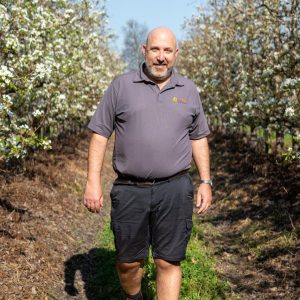
Dennegeur’s Stephan Beukes | Western Cape Farmer of the Year
WESTERN CAPE — Stephan Beukes of Dennegeur Farms in Grabouw has been named the 2026…
Jaco Wolmarans wins Hortgro Photo Competition 2026
Somerset West – Hortgro is proud to announce Jaco Wolmarans as the winner of the…
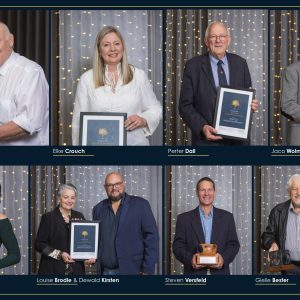
The 2026 Hortgro Awards Celebrate Excellence in the South African Deciduous Fruit Industry
Somerset West — The annual Hortgro Awards brought together leading figures from the pome and…
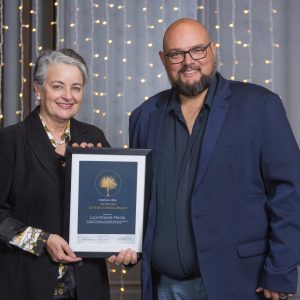
Hortgro Izithelo Media Award 2026 | Lucentlands Media
Hortgro awards the Izithelo Media Award annually for outstanding journalism in and about the deciduous…