

When in drought, innovate
Text: Elise-Marie Steenkamp and Alisa Farr. Pictures: Alisa Farr
The R62 Growth Initiative Strategy (R62G) project, with five weather stations donated by Hortgro, illustrates how the agricultural sector utilises microclimate weather data to understand and mitigate climate change in the Klein Karoo.
Fruit farming in the Klein Karoo presents unique challenges due to the rugged terrain, the presence of microclimates, and the limited water resources. In addition, the topography of the region is far from uniform, with valleys, slopes and kloofs all influencing local weather patterns in significant ways. The area encompasses Montagu, Koo Valley, Barrydale, Ladismith, Calitzdorp, Oudtshoorn, and Prince Albert, all along the well-known scenic Route 62 (R62). The cultivation of pome and stone fruit (fresh, dried and processed) is a critical rural economic driver and job creator. The dry, arid conditions play a significant role in producing great-tasting fruit, and the export of fruit is a key contributor to the Klein Karoo’s economy.
With this area being severely affected by an unprecedented drought that began in 2015 and lasted in some areas until 2022/23, many producers lost orchards. Some lost everything. Others, again, replanted, and some are experimenting with unique cultivars.
According to a drought survey of the Klein Karoo conducted by Hortgro in 2019, over 940 ha were removed, and 296 ha completely died (an estimated R69.9 million loss). With the replacement rate being very slow due to high planting costs and cash flow under pressure, production is 20% lower than the average (resulting in a loss of R119.44 million). The consequential job losses (amounting to a R30.53 million loss in income) were another significant economic impact for the community and the region.
Similar findings were made in a 2020 study by the Western Cape Department of Agriculture (WCDoA). Despite the absolute and relative decline in agricultural gross value added (GVA) in the study area, it remained an essential component of the regional economy. The sector is highly labour-intensive, making it a vital role player in reducing unemployment among residents. It also has important implications for regional food security and significant links to other key sectors, including agri-processing, retail trade, hospitality, and tourism (2020-Klein-Karoo-and-Surrounds; Partridge & Pienaar, 2020).
There is now, more than ever, an increased focus on water management practices in the region, where producers and processors need to improve even more on how they use the same scarce resource, water, to harvest bigger yields, stay sustainable, and remain profitable into the future, all while navigating the challenges of a changing climate.

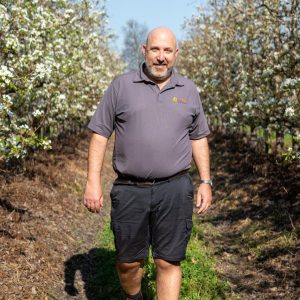
Understanding and capturing weather data are crucial to mitigate crop production practices, says Nitasha Baijnath-Pillay, Hortgro’s Resource Management and Sustainability Manager, who recently met with Niël Joubert, a fruit producer in the Klein Karoo, to learn more about the R62G.
According to Joubert, the R62G was conceived as a community-based approach to try to support perennial crop farmers and their value chains. It currently consists of 21 weather stations that capture data, which is then interpolated to provide accurate climate estimates for specific areas. This enables the understanding of the extent of microclimatic variation across a farm or valley. R62G has partnered with TerraClim, a company that provides agricultural insights based on climate and terrain data. The R62G is a registered non-profit company (NPC) and public benefit organisation (PBO) established to assist in restoring the struggling regional economy through various strategic interventions aimed at climate adaptation. With support from the WCDoA, Hortgro, and other donors, the weather stations were strategically placed to ensure that the weather data is accurate and reliable.
The precise placement was critical, says Joubert, who farms outside Montagu on the R62. All weather stations are positioned to avoid interference from large trees and buildings, which can distort wind readings and temperature measurements. The sites receive full sun and are shielded from disruptive elements, ensuring that the data collected accurately reflects the natural climate.
“These slight but critical variations can have a significant impact on crop production management decisions. Accurate calculations of cold units within a specific microclimate offer vital insight for producers. Understanding the exact climatic conditions on your farm, rather than relying on regional averages, can directly inform decisions about which cultivars are best suited for planting. This localised data enables producers to match crop requirements with real on-farm conditions,” says Joubert.
The weather stations also provide a fire risk index, which helps producers assess the likelihood of veld fires based on temperature, humidity, and wind conditions—vital information for crop protection and worker safety.
According to Joubert, there are no easy fixes, and the road ahead is steep. “Our dream and the inspiration behind the R62G are to help restore Klein Karoo communities to their former glory, preserving them for generations to come. The farms along this route not only provide South Africa with various lines of produce but also play an integral part in the Western Cape’s economy through exports and other value-added activities.
“Farms and the rural business play a significant role in job creation and retention and in preventing overnight urbanisation, adding to the already burdened infrastructure of the bigger towns and cities,” says Joubert.
“What farmers consistently want to know and be sure of is whether they are making the right decisions about where and what to plant and still stay competitive in a climate that’s constantly changing. Statistics are the foundation for sound decisions, but only if the data has integrity and meets the demand for reliable microclimate information. When there are big gaps in the data, we can’t help farmers make informed, long-term decisions about adaptive migration.”
Currently, a research team led by Dr Phumudzo Tharaga of the Agricultural Research Council (ARC), and funded by the Water Research Commission, is conducting a study on the water use of apricots. The study site on Baden Farm near Montagu is a high-performing Imperial orchard on apricot and Mariana rootstock. This study utilises microclimate weather data and plant physiological measurements to determine the water requirements and water productivity of apricots.
Hortgro commended the R62G for making strides in its efforts to mitigate the effects of climate change through monitoring and adaptation, which is the essence of Hortgro’s Climate Change Response Strategy.
R62G weather station fast facts:
- The network of R62G weather stations monitors a wide range of atmospheric and environmental variables.
- Wind speed (minimum/maximum, averages/gusts)
- Wind direction
- Hourly rainfall, with readings captured every few minutes
- Humidity
- Temperature (minimum/maximum/average)
- Daylight hours (crucial for calculating growing degree days and hours)
- Barometric pressure
- Solar Radiation
- The Davis weather stations from Hortgro will be in place for a year in November this year.
- Of the 21 weather stations, one is a roaming station, used to test different areas.
- If growers have weather stations, the R62G can ingest the data, perform various calculations, and make comparisons for a fee.
- Companies or people who would like to contribute towards this invaluable project and support R62G can contact Niël Joubert at niel@r62growth.org.za
Caption main picture: Steyn and Niël Joubert standing next to one of the weather stations in the Klein Karoo.
Related Posts

Patensie does it again!
Honey Katoo takes top honours at Agri’s Got Talent 2026 For immediate release: 17 October…
Dennegeur’s Stephan Beukes | Western Cape Farmer of the Year
WESTERN CAPE — Stephan Beukes of Dennegeur Farms in Grabouw has been named the 2026…

Ek was daar | The roadmap of Anton Rabe
For more than three decades, Anton Rabe has been part of the story of South…
Jaco Wolmarans wins Hortgro Photo Competition 2026
Somerset West – Hortgro is proud to announce Jaco Wolmarans as the winner of the…