
Zonnehaven: step-by-step towards sustainability
Jenny Underhill visited Ceres to talk to a group of growers and production managers from Zonnehaven’s shareholder farms who are passionate about their sustainability journey.
Zonnehaven was established in 2023 as a grower-owned fruit exporter. Two producers, Howbill Farming and Doornkraal Agri, are the major shareholders, with a third, Kalos Farming, owning a minority stake. These family-owned businesses have been operating in the Witzenberg region since 1861 and have a combined farm footprint of 28 000 hectares. The shareholder producers cultivate apples and pears, while Howbill and Kalos also produce a small quantity of stone fruit.
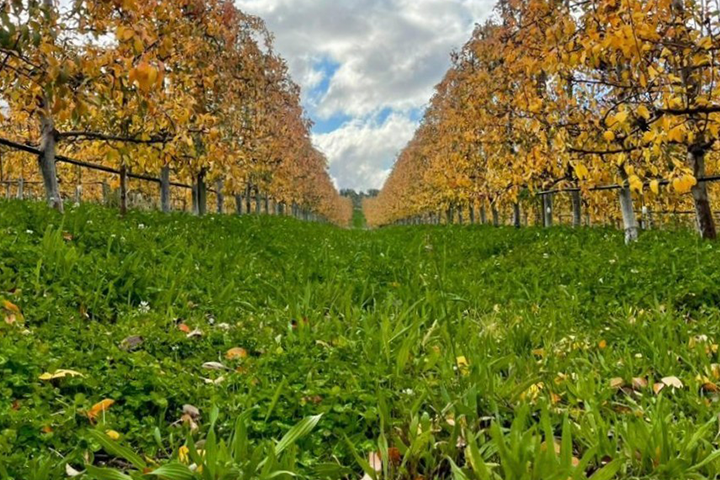
Howbill comprises 500 hectares of orchards, which are all regeneratively farmed. During the 2017/2018 drought, reduced water allocations prompted Howbill’s management team to conserve soil water by mulching the orchards with wood chips. As the mulch’s benefits to soil health became evident, the team was motivated to expand their sustainable farming practices.
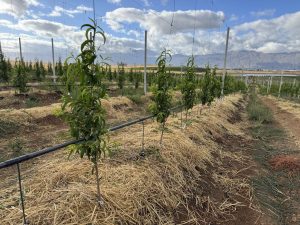 Regenerative practices are gradually being incorporated across all 600 hectares of orchards at Doornkraal. “We want to leave a legacy for future generations of growers. In our case, if we want to plant a new orchard, we are replanting on an old orchard. At the end of the day, we only have a certain amount of water and soil, and he best way of using water more productively is to improve the soil,” explained Daniel Goosen, Zonnehaven Director on behalf of Kalos Farming (2%) and Howbill Farming (48%).
Doornkraal Agri and Howbill have both used trial and error to fine-tune their sustainable farming practices. They learn lessons and share information between the farms’ different production units and across the three shareholder producers’ various properties.
“The teamwork has been rewarding. We learn what’s working at Doornkraal Agri, for example, and try to implement it at Howbill, and vice versa. We don’t just share the good stories. It’s also about what’s not working. We’re not operating in silos,” said Emil Herbst, General Manager: Production at Doornkraal Agri.
Goosen acknowledges the support producers have received from Worldwide Fruit Limited (WFL), an international fruit marketing and distribution company, which has ultimately enabled Zonnehaven to meet the strict requirements of international supermarkets.
 Zonnehaven’s sustainability approach has two components. The first focuses on environmental sustainability and includes alien vegetation management, biodiversity monitoring, regenerative farming practices and initiatives to reduce the shareholder producers’ carbon footprints. The second component focuses on social sustainability. To this end, Doornkraal Agri launched a non-profit organisation, the Noble Earth Foundation, to invest in employee wellbeing, early childhood development, aftercare, and education support.
Partnerships with Blue North Sustainability and ESG Agri have helped Howbill Farming and Doornkraal Agri measure and verify progress toward their sustainability goals. The shareholder producers have gained various accreditations, including SIZA, GlobalG.A.P., BRCGS, Tesco’s Nurture, the Confront Climate Change (CCC) benchmarking initiative, and the Carbon Heroes platform. They are exceptionally proud that Molenrivier, one of Howbill’s key production units, was awarded Tier 4 status through Regenified’s regenerative verification process in August 2026.
Reducing chemical inputs
Zonnehaven’s shareholder producers have phased in many regenerative farming practices while slowly reducing chemical inputs. Their goal is to use the minimum inputs required to produce optimal tonnage per orchard, and they have not stopped their chemical and fertiliser programmes completely.
“Growers are under pressure to obtain optimal yields, and fruit has to be of the required quality and size. If we can’t put fruit in the export cartons, we won’t survive. At the same time, if we do not use responsible farming practices, we won’t be sustainable,” said Ernst van Dyk, estate manager at Howbill Farming.
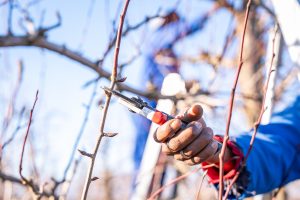
Integrated pest management (IPM) has been a key part of both Doornkraal Agri and Howbill’s strategies to reduce pesticide use. Riaan Schoeman is a production manager at Molenrivier, Howbill Farming. He credits his IPM experience with sparking his passion for sustainable farming.
“We were struggling with pests every day, and we couldn’t control them. We knew we had to do something different and asked realIPM to help us with biological control methods. It turned our situation around, and the next year we started a full IPM program. We use far less pesticide, but it comes with the responsibility to continuously monitor our orchards for pests,” said Schoeman.
Rather than spraying on a schedule, they spray in response to monitoring traps placed throughout the orchards. Agrimotion Consulting assists the team. The data from the monitoring traps, and the traps’ GPS coordinates, are fed into IMPI, an app for easy access and to aid decision-making.
Zonnehaven’s shareholder producers have also changed how they perform soil sampling. Previously, they took one sample per hectare every third year, but now they take about six samples per hectare every second year. This sampling strategy provides far more data at a finer scale and is also readily accessible in IMPI. They now have access to four years of data and can easily see changes over time.
“We can control smaller areas in the block. Using precision spreaders, we can apply chemical inputs to a specific area, which makes the application cheaper and more efficient,” said Herbst.
The benefits of soil armour
Of all their sustainable farming practices, mulch and cover crops have had the biggest impact: improving soil health, reducing water use, and growing resilient trees. Where possible, they chip prunings and put them back into the orchards. Zonnehaven’s shareholder producers have also stopped using herbicide in certain orchards and have achieved a substantial overall reduction in herbicide use.
Growers and production managers affectionately refer to the ‘soil armour’, a metaphor regenerative farmers use to describe the protective covering of living and non-living organic material on the soil surface.
“Traditionally, the consensus was that when you have cover crops in an orchard, the water requirements will increase. What we’ve seen in the last three years is that where we have cover crops in an established orchard, we need less water. This is a result of reduced soil evaporation and better water infiltration because of the cover crops’ root systems,” says Petrus Jordaan, Production Manager at Doornkraal Agri’s Visgat property.
Jordaan admits they have made mistakes while figuring out which cover crops work best for their orchards. “It’s a process of trial and error. We’re also encouraging more perennial crops so that we don’t have to sow every year.”
For many growers and managers at Howbill and Doornkraal Agri, the best thing about the soil armour is seeing life return to the soil, with more birds and butterflies in the orchards. “You can see the difference in the soil where we are mulching, using compost and growing cover crops. Previously, when we sprayed herbicide on the ridges, the ground was hard, and you couldn’t dig with your hands. Now you can dig a hole easily and see earthworms,” said Jordaan.
Future goals
Goosen says the results that they have achieved have given him the confidence to keep implementing sustainable practices. One of his biggest aims is to reduce the use of ‘hard’ pesticides and transition to more biological products.
He would also like to improve how they plant new orchards. Most orchards still use the old system, with rows 5 metres apart. Converting the rows to 3.5 metres results in intensive tillage, effectively undoing the work they have done to build healthy soil. Goosen envisages that it will be easier to keep tillage to a minimum in the future, in 15 to 20 years’ time, when they will replant in the same rows.
“Zonnehaven’s brand tagline is ‘Cultivate Perfection’,” says Herbst, “I think it gives you a good idea of our farming philosophy.” The teams at Zonnehaven’s shareholder producers will keep solving challenges as they arise and make incremental changes that add up to big improvements.
Related Posts
Hortgro’s Mentor and Internship Programme, through the Skills Accelerator Programme
The Hortgro Mentor and Internship Programme offered participants a learning opportunity outside their usual internship…
Critical Water Shortages Irrigation Guidelines for Deciduous Fruit Trees
Droughts require using every drop of water as economically and efficiently as possible. The greatest…
Be better today than yesterday
“It’s an honour to have been named the 2026 Western Cape Farmer of the Year…
The circles of life
By Gerrit Rautenbach Cedrico Rhode has had a remarkable journey so far, from a Koue…