
SIZA Does Matter
The 10-year conference of The Sustainability Initiative of South Africa (SIZA) took place on 19 August at Ashanti, near Paarl.
By Gerrit Rautenbach
SIZA’s raison d’être is to cultivate ethical and environmentally sustainable trade practices across a wide range of agricultural commodities. Hortgro representatives Calla du Toit, Mariette Kotze and Georgie Hewitt were among the participants who shared their perspectives. Werner van Dyk, SIZA’s COO, chaired the conference and asked each participant a tough question.
Question to Calla du Toit (Hortgro Pome Chairman and Procurement Director, Tru-Cape Fruit Marketing): Why is it misleading to separate ethical and environmental compliance from production processes when compliance is an investment and essential part of modern farming practices and market readiness?
First of all, that is more than a question, I think; it’s more like a total topic. But first, congratulations to SIZA on this milestone and on being as substantial as this … well, question. I will try to answer it, as it is about technical and environmental compliance, which is central to our new agenda.
Why do we need it? Because global interest in South African fruit is rising. So it will be forced upon us, not only by our clients but by both our southern and northern hemisphere competition. The question they ask and that we must ask is: can we be trusted as a truly world-class supplier? We need global retail options. The good ones, but the tough ones too! And is it happening? You look at new markets opening up. China and more. It’s happening. And with competition being so tough, compliance is an investment and essential part of modern farming. Yet anyone competing for market share will constantly ask our clients whether we comply with proper ethics. We must always make sure our competitors can never point a finger at us on this issue. This, again, means establishing a culture of strong standards and environmental awareness. Why? Because we owe it to the next generation. Fortunately, they have a heightened sense that we must look after the environment, we must look after the people who work with us, and, I think, very importantly, there is a culture of good practice and environmental awareness.
However, the great thing about ethical and environmental compliance is that you write your own story. My question is, do we have a good story to tell? First, we have the most diverse biodiversity system of any fruit-growing country in the world. This helps keep ecosystems stable and resilient, supports food production, and helps ensure clean water and air. Amongst others.
In the Western Cape, we farm between fynbos and mountains. As most of you know, fynbos is one of the world’s most diverse biomes. Fynbos-covered mountains catch winter rainfall, slow it down, and allow water to feed underground aquifers and rivers. Unlike trees, it doesn’t drain reservoirs. South Africa has more sunshine hours than any other fruit-producing country in the world. This is self-explanatory. We have multiple production zones, and lately we pay more attention to micro-climates than ever before. A couple of great chapters, making up a good story, I’d say.
To summarise, start seeing ethical and environmental compliance as a tool, not a burden. Hand in hand with that, relationships and mutual respect are more important than ever. And remember, quality fruit alone is simply not good enough anymore. So go and create your farm’s own story. Make it a SIZA bestseller.
Question to Mariette Kotzé, General Manager: Industry Support Services, Hortgro: How can organisations measure whether policies are being effectively implemented rather than simply documented and audited?
We are not just farming for fruit. We are farming with people ̶ and within an environment. I want to start there because, for me, ethical employment and environmental responsibility are not things that sit alongside the farming business. They are part of the production system itself.
A fruit farm depends on people ̶ their skills, experience and commitment. It also depends on the environment ̶ soil, water, biodiversity and natural resources.
The five P’s are not just the measurement mechanism; they are dimensions or definitions of sustainable value outcomes. For me, these five P’s describe what responsible and sustainable farming ultimately needs to deliver.
- People: safety, dignity, skills and wellbeing.
- Planet: the natural resources that make production possible.
- Place: the communities and rural economies in which we operate – relationships are important.
- Profit: the commercial viability needed to keep investing and growing – expanding opportunities.
- Price: whether the value chain recognises the cost of producing responsibly, to remain competitive and to add value.
The five P’s are the “Why”. SIZA is the “How”. How do we know that the policies we put in place are actually being implemented, rather than simply documented and audited?
The core problem is that the policy is not the implementation. A policy can be completely compliant and still be ineffective. On the one hand, we have the policy; on the other, what happens in practice. What’s in the file versus the real test: what happens on the farm.
Take PPE as a simple example. We need to ask: can the workers tell us why PPE is needed? Do they understand the risks for the business? Does the supervisor enforce and reinforce the requirements? Is the right PPE equipment issued and actually being used? Do worker interviews, observations and records tell the same story?
Because if I have issued the PPE, trained the worker, and have a signed register, but the worker doesn’t understand the risk, I may be compliant, but I’m not necessarily effective. That takes us from documentation to implementation. So the focus shifts to what changed because of the policy.
I don’t think the answer is to criticise audits. I think audits are extremely valuable. We don’t always know what we don’t know. Audits help us find our blind spots. An independent audit gives management another lens. It can expose the gap between what management thinks is happening and what is actually happening.
That’s why I don’t see a non-conformance as an audit failure. I see it as the audit doing its job ̶ identifying something we weren’t seeing.
The question shouldn’t be only: how do I close this finding? It should be: why did the system allow it to happen? That takes us into root cause, system change and measurement, building resilience in the system.
There is also a positive side. An effective audit should identify bright spots as well as blind spots. SIZA’s recognition of Best Practices is important here. If a farm, team, or department is doing something particularly well, we should ask what makes it work, whether we can measure its value, and whether we can share and replicate the practice to drive continuous improvement.
We’re talking about a system affecting more than 112 000 workers in the stone fruit value chain. Therefore, when we talk about ethical labour and environmental compliance, we’re not talking about an administrative exercise. We’re talking about people’s daily working lives.
So how do we know whether a policy is alive and implemented? There is a long list of practical examples where policy definitely translated into practice. To name but a few:
- Maintenance of key markets
- High levels of social and environmental compliance
- Ability to demonstrate continuous improvement and moving beyond compliance
- SIZA is a recognised standard reducing the cost of compliance (volume of standards and regulations)
- 2012 farm worker strikes and demands being implemented
- Foresight to develop environmental standards before becoming mandatory, and already measuring the impact of these practices
- Data demonstrating and measuring sustainable and ethical practices used for decision making.
Effective implementation doesn’t always produce an immediate visible financial return. Sometimes the value is value created, but sometimes it is value protected, loss and/or risk avoided. Sometimes a policy’s value isn’t what it generates, but what it prevents us from losing.
And this is where measuring the value of compliance becomes difficult. We can measure the cost of implementing a policy quite easily. It is much harder to measure the value that was unlocked ̶ or the loss that was avoided because we implemented it.
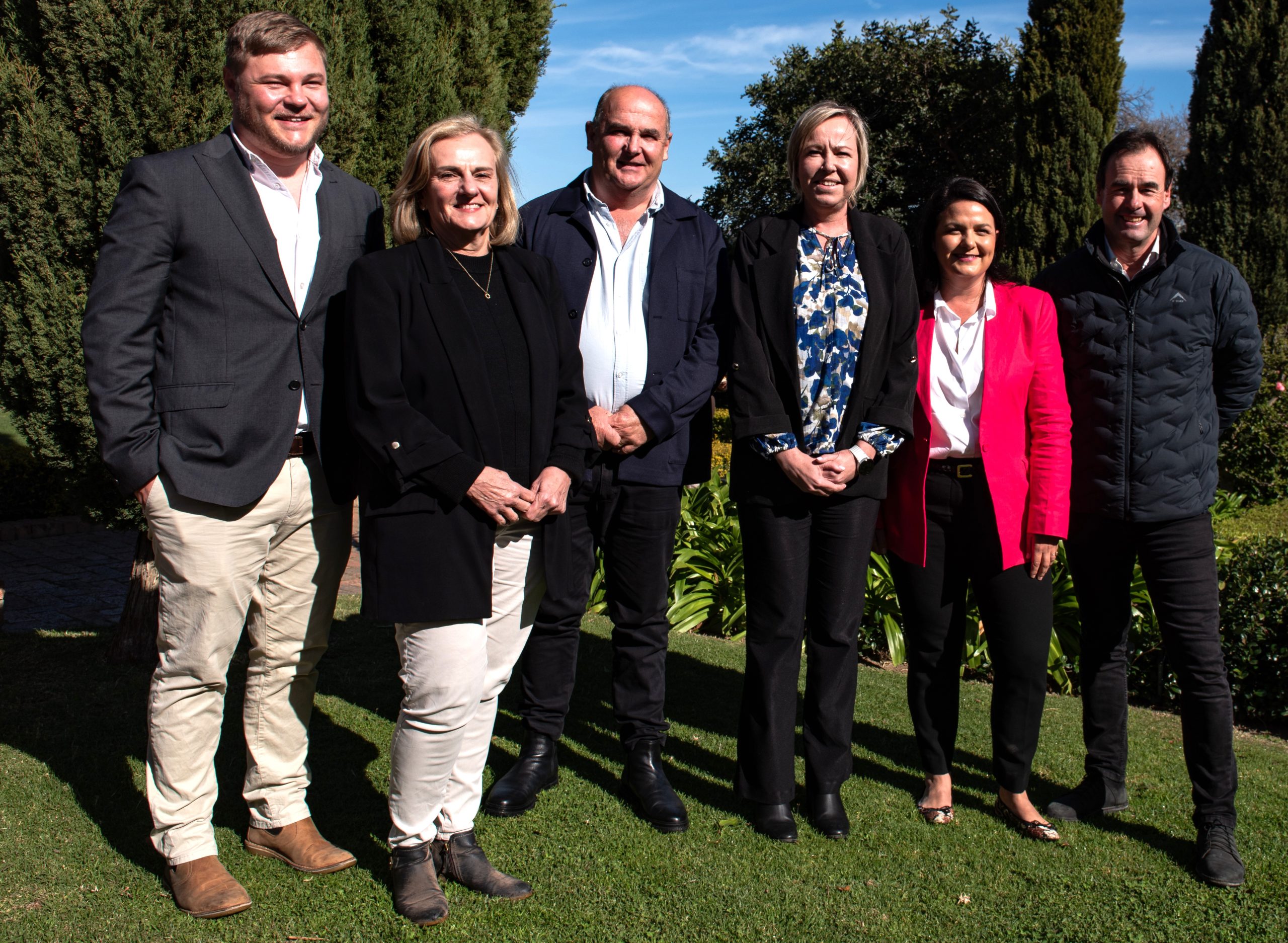
Caption: From left, Werner van Dyk, Retha Bekker, Nic Dicey, Mariette Kotze, Georgie Hewitt and Calla du Toit
Related Posts
Burn Baby Burn | Invasive Tree Management Builds Water Security
Liz Metcalfe is co-director and organisation coordinator at Living Lands. She spoke to Jenny Underhill…

After 25 Years, Tru-Cape’s Henk Griessel Steps Back — But Not Away
At the end of July 2026, Henk Griessel officially retired from Tru-Cape Fruit Marketing after…
Pollination in the spotlight
It is that time of year when pollinators work hard to ensure a successful production…
SIZA – From compliance to competitive advantage
Text: Gerrit Rautenbach Georgina Hewitt, co-owner of Verdun Estates, Hortgro Stone Vice-Chairperson, and SIZA Board Director,…